
























Network Penetration Testing Explained: Methods, Benefits, and Key Steps
Understand the process of network penetration testing, different types, key steps, vulnerabilities, advantages, and its significance in enterprise security.

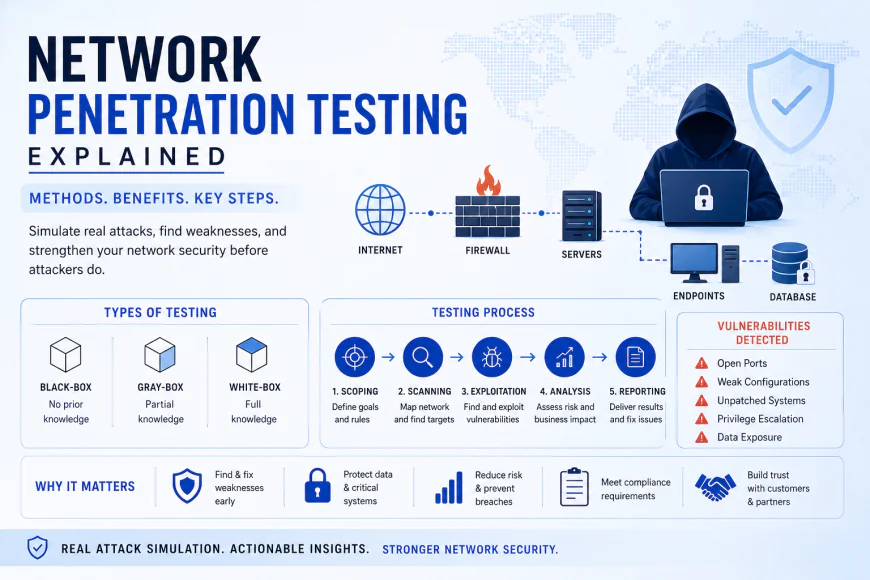
Every organisation with an Internet presence is a target. Attackers don’t need to be geniuses; they just need one unpatched server, one weak password, or one misconfigured firewall rule to get in. That’s why network penetration testing has become one of the most important practices in modern cybersecurity. It shows in practical terms what a real attacker could do to your network before the attacker has the chance to do it.
Here’s what you’ll find in this guide: what network penetration testing is, types and methods of testing, how the process works, and why it’s become a non-negotiable component of enterprise security programs.
Table of Contents
-
What Is Network Penetration Testing?
-
How Does Network Penetration Testing Work?
-
Types of Network Penetration Testing
-
The Network Penetration Testing Process
-
Why Companies Perform Network Penetration Tests
-
Common Vulnerabilities Detected by Network Penetration Testing
-
Network Penetration Testing in Modern Enterprise Environments
-
Final Thoughts
What Is Network Penetration Testing?
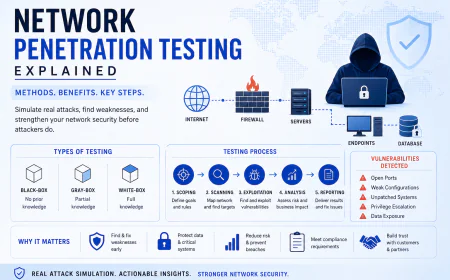
Network penetration testing is a controlled, authorised simulated attack against an organization’s computer network, infrastructure, and connected systems. The goal is to find exploitable vulnerabilities in firewalls, routers, servers, endpoints, wireless access points, and network protocols before malicious hackers find and exploit them.
A penetration test, unlike automated vulnerability scans that just flag known weaknesses, is carried out by skilled security professionals (often referred to as ethical hackers) who think and act like real attackers. Not only do they find vulnerabilities, but they try to exploit them, chain them together, and show real business impact, such as accessing sensitive data or taking control of critical systems.
How Does Network Penetration Testing Work?
Network penetration testing is basically a simulation of the tactics, techniques, and procedures (TTPs) used by real-world cybercriminals. Testers use a blend of automated tools and manual, hands-on techniques to find weaknesses in the network perimeter and internal infrastructure.
The process usually involves:
- Mapping the network to understand its structure, devices, and attack points
- Identifying open ports, running services, and legacy software
- Experimenting with found vulnerabilities in a safe, controlled manner
- Privilege escalation to see how far an attacker might get in once inside
- Documenting every step so the organisation can reproduce and correct the problems
This can be done remotely (over the internet) or on-site (connected directly to the internal network), depending on whether the goal is to mimic an external attacker or an insider threat.
Types of Network Penetration Testing
Network penetration testing is usually divided into two parts: what the tester knows and where the testing happens. Network penetration testing can be simple or very detailed depending on what the tester's told and where they do the testing. The tester may know a lot or a little about the network they are testing. They may test the network from inside or outside. This makes network penetration testing different each time it is done on a network. Penetration testing of networks generally falls into two categories based on the amount of information the tester is given and the location of the testing.
By level of knowledge:
-
Black-box testing: The tester has no prior knowledge of the network, mimicking a real external attacker starting from nothing.
-
White-box testing: The tester has access to network diagrams, credentials, and system documentation, allowing for a more thorough and in-depth evaluation.
-
Grey-box testing: The tester has partial knowledge, such as an attacker who has gained some level of access or an insider who has some privileges.
By network scope:
-
External network penetration testing: Targets internet-facing assets like firewalls, VPNs, web servers, and email gateways to simulate an outside attacker trying to penetrate the perimeter.
-
Internal network penetration testing: Tests what happens when an attacker (or malicious insider) has already gained a foothold inside the network, testing lateral movement, privilege escalation, and access to sensitive systems.
-
Wireless network penetration testing: Tests Wi-Fi infrastructure for weak encryption, rogue access points, and authentication flaws.
-
Cloud network penetration testing: Evaluates misconfigurations, weak identity and access management, and exposed storage in cloud-hosted infrastructure (AWS, Azure, GCP).
Most mature security programs use a mix of these types over time to get a full picture of both perimeter and internal risk.
Also Read: What is Network Security? A Complete Guide
The Network Penetration Testing Process
Methodologies will differ slightly between companies and frameworks (such as PTES, OSSTMM, or NIST SP 800-115), but the vast majority of network penetration tests will follow a similar structured process.
1. Scoping and planning: The scope, objectives, rules of engagement, and legal authorisation are defined by the organisation and the testing team. In this step, we define the systems that can be tested, the forbidden techniques, and the time window for testing.
2. Reconnaissance: Testers collect information about the target network through passive (public records, DNS lookups, social media) and active techniques (network scanning) to develop an understanding of the attack surface.
3. Scanning and enumeration: Tools to find live hosts and open ports, running services, and software versions. This allows testers to find probable weaknesses and old systems.
4. Exploitation: Testers try to find ways to take advantage of the weaknesses they have found. For example, they might try to get into the system by using a service that has not been updated, guessing passwords, or finding a way around a firewall rule that is not set up correctly. This is done to see if they can get into the system without permission.
5. Post-exploitation and lateral movement: Once testers are inside the system, they see how much they can do. They try to gain access, move from one system to another, and get to sensitive information. This shows what could really happen to the business.
6. Making a report and suggesting fixes: The last step is to make a report. This report says what weaknesses were found, how they were used, how they could affect the business, and what should be done to fix them.
7. Testing again: After the fixes are made, testers do another test to make sure the weaknesses are really fixed and that no new problems were created.
Why Companies Perform Network Penetration Tests
Organisations invest in network penetration testing for a lot of reasons that are all connected. They want to identify the risks that their network faces.
-
Identify real-world risk: Vulnerability scanners can give them a list of potential issues, but network penetration testing shows which of these issues are really a problem and can be used to harm the organization.
-
Meet compliance requirements: Standards like PCI DSS, HIPAA, ISO 27001, and SOC 2 usually require organisations to do network penetration testing regularly.
-
Protect sensitive data: Network penetration testing helps organisations protect information. This includes customer records, intellectual property, and financial information, which are all very important to the organisation.
-
Validate security investments: Network penetration testing also helps organisations make sure their security measures are working. They can check if their firewalls, intrusion detection systems, and other security controls are doing what they are supposed to do.
-
Reduce financial and reputational risk: A security breach can lead to millions in costs for fixing the problem, paying bills, and losing customer trust; testing is much less expensive than dealing with an actual incident.
-
Support incident response readiness: Testing shows us where we are falling short when it comes to detection and response. This helps the security teams to get better at finding attacks and stopping them from causing more harm. The security teams can then improve their response to an attack, like a cyberattack, and this is what testing is really good for; it helps the security teams to see what they need to work on. Testing is very important for security teams because it helps them to be ready for an attack and to respond to the attack quickly.
Common Vulnerabilities Detected by Network Penetration Testing
Penetration tests routinely uncover a recurring set of weaknesses across organisations of all sizes:
-
Unpatched software and outdated operating systems
-
Weak, default, or reused passwords
-
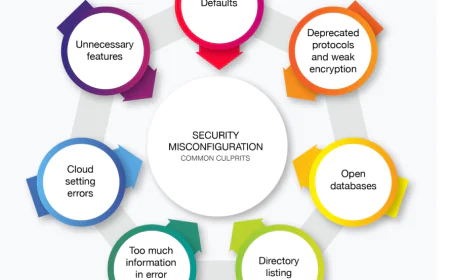
Misconfigured firewalls and network devices
-
Open or unnecessary ports and services
-
Poor network segmentation, allowing easy lateral movement
-
Insecure remote access configurations (VPNs, RDP)
-
Weak or outdated encryption protocols
-
Missing or improperly configured multi-factor authentication
-
Exposed administrative interfaces
-
Insufficient logging and monitoring, which delays breach detection
Each of these, on its own, might seem minor. But skilled attackers often chain several small weaknesses together to achieve full network compromise, which is exactly why manual, expert-led testing matters so much more than automated scanning alone.
Network Penetration Testing in Modern Enterprise Environments
Enterprise networks today are far more complex than they were a decade ago. Hybrid work, cloud adoption, IoT devices, third-party integrations, and multi-cloud environments have all expanded the attack surface. A single enterprise network can now include on-premises data centres, multiple cloud providers, remote employee devices, and dozens of SaaS integrations, each creating another potential entry point. Platforms such as IntelligenceX can help organisations take a more proactive approach to finding and addressing security risks across this growing environment.
This complexity has changed how penetration testing is approached:
-
Continuous testing over annual assessments: Many enterprises now test more frequently instead of relying on a single yearly assessment, because new vulnerabilities can appear at any time.
-
Cloud-native testing expertise: Testers need to understand cloud-specific risks such as identity misconfigurations and container security, alongside traditional network infrastructure.
-
Integration with DevSecOps: Findings are increasingly fed into development pipelines, helping teams fix vulnerabilities earlier in the development process.
-
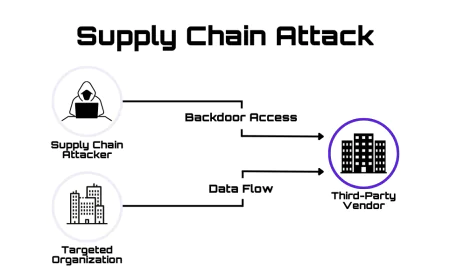
Focus on supply chain risk: With third-party vendors and APIs deeply connected to enterprise networks, testing often needs to look beyond the organisation's own perimeter.
-
Purple team collaboration: Many enterprises bring penetration testers (red team) and internal defenders (blue team) together to improve detection and response capabilities during testing, rather than waiting until afterwards.
Conclusion
In other words, network penetration testing should not be considered as a process of ticking a box but rather an area of continuous activity that allows an organisation to determine its true security posture from the point of view of an attacker.
By using a combination of appropriate types of testing, a methodology for testing, and manual analysis by experts, companies can detect and eliminate critical weaknesses in their network security in order to prevent breaches. The more complicated networks become, and the more advanced attackers become, the more necessary it becomes to regularly carry out a comprehensive penetration testing process.
If you want to test the security of your network, get additional information on the network penetration testing offered by IntelligenceX.