















The Growing Hidden Threat to Enterprise Security, Governance, and Compliance
Complete analysis of Shadow AI vulnerabilities covering unauthorized AI tool adoption, data leakage risks, compliance failures, case studies, differences from Shadow IT, detection methods, governance frameworks, and organizational strategies to implement responsible AI adoption while maintaining security oversight.
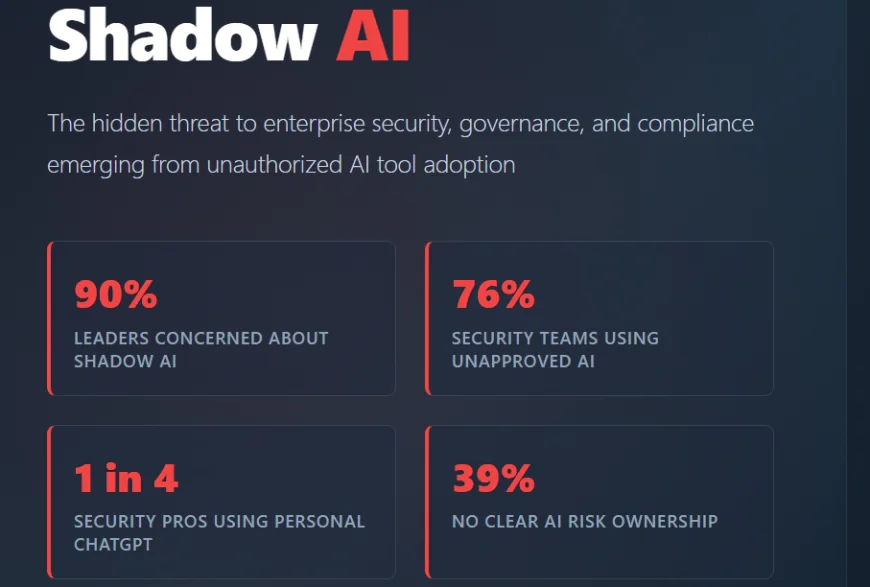
Imagine walking through your organization and discovering that 90 percent of employees are using unauthorized tools to process sensitive company data and nobody in IT knows about it. This isn't a hypothetical scenario. This is the reality of Shadow AI in 2025.
Shadow AI represents one of the fastest-growing security blind spots in modern enterprises. Unlike Shadow IT, which emerged gradually as employees adopted cloud apps and file-sharing tools, Shadow AI spreads at light speed because the tools are so easy to use, so embedded in workflows, and so tempting to leverage.
A developer pastes proprietary code into ChatGPT to debug it. A marketing manager uploads confidential strategy documents to Claude to summarize them. A financial analyst uses an unauthorized AI tool to process customer data. None of them intends harm. They just want to work faster.
But that code, that document, and that data are now sitting on third-party servers outside your organization's control. And nobody in security knows it happened.
The result: intellectual property exposure, compliance violations, breach notifications, and regulatory fines that can cost organizations millions of dollars.
This is the Shadow AI crisis.
What Is Shadow AI and How Does It Differ From Shadow IT?
Shadow AI refers to the unsanctioned use of generative AI tools, AI agents, AI-powered IDEs, browser extensions, or AI SaaS applications without formal approval, visibility, or governance by IT or security teams.
It sounds similar to Shadow IT, which has existed for decades. Shadow IT is when employees use unapproved software or cloud services (like Dropbox instead of approved file storage, or Slack instead of enterprise chat) to bypass IT controls and work faster.
The critical difference is what these tools do with your data.
Shadow IT typically stores or moves data. An employee uploads files to personal Dropbox. Data sits there, potentially exposed if the account is compromised, but it doesn't change or generate new information.
Shadow AI, by contrast, processes, interprets, learns from, and generates new content based on your data. It makes autonomous decisions. It learns from interactions. It can take actions on behalf of users.
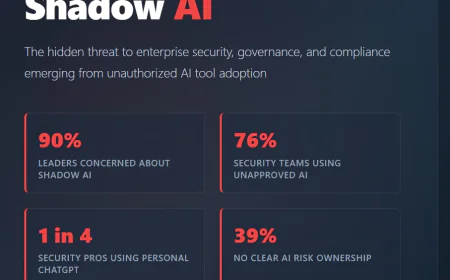
A 2025 survey from Mindgard revealed that nearly one in four security professionals admit to using unauthorized AI tools, and 76 percent estimate their security teams are using ChatGPT or GitHub Copilot without approval. This happened inside the teams meant to protect the enterprise.
The scale and speed are unprecedented. Shadow IT took years to become a widespread problem. Shadow AI achieved that status in months.
The Real Risks: Why Shadow AI Is Different and Dangerous
Data Leakage and Intellectual Property Exposure
The most immediate Shadow AI risk is unintended data leakage. When employees paste information into AI tools, that data is often stored, logged, and potentially used for training.
Real example: A software engineer uses ChatGPT to refactor legacy code. He pastes proprietary code into the public ChatGPT interface, never realizing that data now exists on OpenAI's servers. That code could be stored, logged, or analyzed. Worse, the AI-generated output might include insecure logic or code that violates licensing terms.
Another example: A communications specialist uploads a confidential strategy memo into an AI tool to get help summarizing it. That proprietary content—including unannounced product launches, competitive intelligence, and financial projections—is now sitting on third-party servers.
A 2025 research study from Mindgard found that security professionals report entering internal documentation, customer records, and sensitive data into AI tools. Twelve percent admit they don't even know what data is being input.
Real-world impact: In 2023, Samsung was one of the first companies to ban ChatGPT use after discovering sensitive internal information was being exposed through unauthorized use. They moved quickly to prevent worse damage.
Compliance Violations and Regulatory Fines
Shadow AI directly violates modern data protection regulations. When EU customer data is leaked through unauthorized AI use, organizations can be fined up to 4 percent of global revenue under GDPR. PCI DSS violations can result in losing major customers and millions in fines. HIPAA breaches can destroy healthcare organizations' reputations.
Compliance frameworks like GDPR, HIPAA, CCPA, SOC 2, and PCI DSS were not built for AI. They weren't designed to handle the complexity of data being sent to external AI platforms, processed by machine learning models, potentially logged for training, and analyzed by third parties.
Shadow AI sidesteps these frameworks entirely. When it violates them, organizations face enforcement actions, penalties, and customer trust erosion.
Loss of Model Transparency and Control
When employees use unauthorized AI tools, organizations lose visibility into what models are being used, how they're being trained, and what data they're learning from.
This becomes critical when AI systems produce problematic outputs. AI hallucinations (when models generate confident but false information) can mislead employees into making incorrect business decisions. AI bias can result in unfair outcomes that violate discrimination laws. Malicious AI outputs can be used for phishing or social engineering.
Without visibility into which models employees are using, organizations can't audit, validate, or control these risks.
Autonomous System Behavior Beyond Governance
Unlike traditional Shadow IT, Shadow AI systems can take independent action. AI agents can make decisions, execute commands, and automate workflows without human review at every step.
An employee deploys an unauthorized AI agent to automate customer service responses. The agent starts interacting with customers, making commitments, and potentially making errors. All outside governance. All outside legal review.
If that agent makes a mistake with financial implications, provides incorrect medical advice (if in healthcare), or violates customer privacy in responses, the organization faces liability for actions taken by unsanctioned systems.
Security Vulnerabilities and Attack Surface Expansion
Unauthorized AI tools create unmanaged connections to external platforms. These connections are new attack surfaces that IT security teams don't monitor or protect.
A compromised AI tool integrated into customer service workflows could become a vector for phishing attacks. Employees use their enterprise credentials to log into public AI systems, potentially exposing those credentials. Unsecured API connections to AI platforms can be intercepted.
IT teams lack visibility into who's using what, making effective security monitoring impossible.
Reputational Damage and Customer Trust Erosion
When Shadow AI leads to data breaches or compliance violations, the reputational damage extends beyond the immediate incident. Customers worry about what other data might have been leaked. Partners question the organization's security practices. Regulators increase scrutiny.
In 2025, an organization's reputation is increasingly built on trust in how they handle data and AI systems. Shadow AI erodes that trust visibly.
Why Employees Use Shadow AI: The Root Cause
Before addressing how to prevent Shadow AI, understand why it's happening in the first place.
Employees aren't deliberately trying to circumvent security. They're trying to work faster and more efficiently. In most cases, they don't realize the risks.
Common reasons employees adopt Shadow AI:
Approved tools are perceived as slow or insufficient for their needs
Centralized IT teams are stretched thin and slow to approve new tools
AI tools are so easy to use they don't register as "special tools requiring approval"
Peer pressure: "Everyone else is using ChatGPT, so it must be safe"
Lack of awareness about data privacy implications
Perception that "it's just a chatbot, how bad could it be?"
Lack of viable approved alternatives
This is critical: the problem isn't malicious intent. Most Shadow AI use is unintentional. Employees think they're being productive. They don't realize they're exposing company data.
This means enforcement-only approaches fail. Banning tools simply drives usage underground. Blaming employees for not knowing the risks is unfair when organizations haven't communicated the risks or provided better alternatives.
Detection: How to Find Shadow AI in Your Organization
✅ The first step in managing Shadow AI is gaining visibility into where it's happening.
Detection methods include:
✅ Network monitoring tools that identify API calls to external AI platforms and identify AI tool traffic signatures
✅ Cloud Access Security Brokers (CASBs) that flag unsanctioned AI endpoints and cloud services
✅ Endpoint Detection and Response (EDR) tools that alert on suspicious command-line activity linked to model APIs
✅ Data Loss Prevention (DLP) tools that can identify when sensitive data is being sent to external services
✅ User behavior analytics that detect anomalous data transfers or access patterns
✅ Monitoring for AI-specific indicators like unusual GPU usage, LLM telemetry signals, or model API tokens
✅ Browser extension scanning that identifies installed AI tools
✅ User interviews and surveys asking directly about AI tool usage (often revealing because it's framed as discovery, not enforcement)
However, most detection is hampered by the fact that AI tools operate over encrypted HTTPS connections. IT teams can see that traffic is going to OpenAI or Anthropic, but can't see what data is being sent without decryption (which creates privacy issues).
A 2025 F5 report highlights this challenge: organizations need detection and prevention specifically for AI workloads and unauthorized use over encrypted channels—an emerging capability gap.
Governance Framework: Building Responsible AI Adoption
The solution to Shadow AI isn't prohibition. Industry experts consistently recommend governance, visibility, and education over blanket bans.
Here's why bans fail: they're impossible to enforce, they suppress innovation and morale, they make employees resentful, and they drive AI use further underground where it's even harder to detect and control.
Instead, build a governance framework that enables responsible AI adoption:
1. Establish Clear AI Usage Policies
Define exactly what employees are allowed to do with AI tools. Specify which tools are approved. Clarify what data can and cannot be shared. Explain the reasoning—so employees understand why policies exist, not just what the rules are.
Example policy elements:
Approved list of AI tools (with updated versions)
What types of data can be shared (e.g., "no customer PII, no source code, no trade secrets")
Required approval process for new tools
What constitutes acceptable use cases
Expectations for documenting AI tool usage
Data handling requirements for different classification levels
2. Create a Vetted AI Tools Registry
Maintain a public-facing list of approved AI tools that have been evaluated for data privacy, security, and regulatory compliance. Make this list easily accessible and visible.
Encourage employees to use these sanctioned options by making them conveniently available (single sign-on, pre-licensed, integrated with workflows).
Examples of sanctioned options:
Enterprise versions of ChatGPT with logging and data loss protection
Claude (Anthropic) enterprise version with SOC 2 compliance
Internal AI assistants integrated into company platforms
Custom models built on private, enterprise-grade infrastructure
Proprietary models deployed on internal infrastructure
3. Implement AI Registry and Inventory
Create a living registry of all AI tools, models, and agents in use within the organization. This isn't about punishment, it's about asset management.
Each registered AI model should have designated ownership and stewardship. The steward monitors:
Data quality
Retraining cycles
Ethical use
Output validation
Compliance alignment
This transforms Shadow AI governance from policing to partnership.
4. Build Training and Awareness Programs
Most Shadow AI misuse is unintentional. Help employees understand the risks.
Training should cover:
Data privacy implications
How AI systems learn from training data
AI hallucination and reliability issues
Compliance requirements
Best practices for responsible AI use
Real-world examples of AI-related breaches
Most importantly: train security teams. In the Mindgard study, even security professionals didn't understand the risks well enough to avoid them.
5. Implement Lightweight Approval Workflows
Rather than long bureaucratic approval processes, implement simple registration workflows. An employee discovers a useful AI tool and registers it (with description of purpose and data classification). Security and compliance teams conduct lightweight risk reviews and assign an "approved" designation.
This approach shifts governance from policing to partnership, encouraging visibility instead of avoidance.
6. Establish Identity Governance for AI Systems
As agentic AI becomes more common, these systems need identity governance just like human users do.
Assign credentials to AI systems. Control what data they can access. Audit their actions. Revoke access when systems are decommissioned.
Only 48 percent of organizations currently have identity governance for AI entities—a critical gap given autonomous system proliferation.
7. Deploy Monitoring and Continuous Auditing
Monitor for suspicious patterns:
Unusually large data transfers to external services
Frequent API calls to AI platforms from unusual users or at unusual times
Multiple simultaneous connections to different AI platforms
Data exfiltration attempts
Use behavioral analytics to establish baselines and alert on deviations.
Importantly: frame monitoring as helping catch threats, not spying on employees. Frame auditing as compliance verification, not punishment.
The Strategic Approach: Balancing Innovation with Security
The most successful organizations are those that treat Shadow AI governance not as a problem to suppress, but as an opportunity to align employee innovation with enterprise security and compliance.
Key principles:
Enable innovation rather than prohibit it
Invest in secure AI alternatives with equivalent capabilities
Provide clear paths to approval, not barriers
Build accountability across business units (don't push all responsibility to IT)
Treat governance as a shared responsibility, not IT's burden
Invest in automation that makes compliance frictionless
Recognize that some Shadow AI use is probably inevitable—the goal is to manage it, not eliminate it
The Strategic Investment: Building Enterprise AI Infrastructure
The most mature approach is building enterprise-grade AI infrastructure that employees prefer to using public tools.
This requires:
Enterprise AI platforms (ChatGPT Enterprise, Claude API with enterprise contracts)
Custom models deployed on private infrastructure (using foundations from OpenAI, Anthropic, open-source options)
Retrieval-Augmented Generation (RAG) systems that connect models to proprietary knowledge bases, ensuring accuracy and compliance
Strong governance controls on data access and model outputs
AI risk registers tracking all AI systems and their compliance status
Integration with security operations centers (SOCs) for continuous monitoring
This approach is more expensive and requires engineering effort. But it provides control, security alignment, and the visibility to detect remaining Shadow AI use.
Conclusion: Shadow AI Is Here to Stay, But It Can Be Managed
✅ Shadow AI isn't going away. AI tools are too valuable, too easy to use, and too embedded in workflows. Employees will continue using them to work faster—with or without approval.
✅ The organizations that win are those that recognize this reality and build governance systems that balance productivity with security. They gain visibility into AI usage, establish clear policies, provide approved alternatives, and create accountability across the enterprise.
✅ The organizations that fail are those that try to enforce prohibitions, that lack visibility, that don't provide alternatives, or that treat Shadow AI as purely an IT problem rather than a business and culture challenge.
✅ A 2025 study found that 90 percent of enterprise leaders are concerned about Shadow AI from a security and privacy standpoint. Yet most lack comprehensive controls to address it.
✅ Shadow AI represents a critical moment for enterprise leadership. Treating it as a threat to be eliminated won't work. Treating it as an inevitable evolution that needs governance, transparency, and accountability—that's the path forward.