























What is Network Security? A Complete Guide
Learn what network security is, why it is important, how it works, common threats, security controls, and best practices to protect enterprise networks from cyberattacks.


Introduction
Modern organizations depend on computer networks to connect employees, customers, cloud services, applications, and business systems. As businesses become increasingly digital, protecting these networks from cyber threats has become one of the most critical responsibilities of every organization.
Cybercriminals constantly attempt to exploit vulnerable networks through ransomware, malware, phishing, denial-of-service attacks, credential theft, and unauthorized access. A single successful attack can disrupt operations, expose sensitive information, and result in significant financial and reputational damage.
Network Security is the practice of protecting network infrastructure, connected devices, and the data transmitted across networks from unauthorized access, misuse, and cyber threats. It combines security technologies, policies, processes, and continuous monitoring to ensure that communication remains secure and business operations continue without interruption.
Whether an organization operates an on-premises data center, a hybrid environment, or a cloud-first infrastructure, network security plays a fundamental role in maintaining confidentiality, integrity, and availability.
In this guide, you'll learn what network security is, how it works, its key components, common threats, best practices, and why it remains an essential part of every cybersecurity strategy.
Table of Contents
- What is Network Security?
- Why Network Security is Important
- How Network Security Works
- Types of Network Security
- Core Components
- Common Network Threats
- Benefits
- Best Practices
- Frequently Asked Questions
What is Network Security?
Network Security is the practice of protecting computer networks and the information transmitted across them from unauthorized access, cyberattacks, misuse, and disruption.
It combines hardware, software, security policies, and operational procedures to safeguard an organization's network infrastructure.
The primary objectives of network security are to:
- Prevent unauthorized access
- Detect malicious activity
- Protect sensitive data
- Ensure secure communication
- Maintain business continuity
Effective network security covers internal networks, cloud environments, wireless networks, remote connections, and internet-facing systems.
Why is Network Security Important?
Organizations exchange enormous volumes of sensitive information across their networks every day. Without proper security controls, attackers can intercept communications, steal confidential information, disrupt services, or gain unauthorized access to critical systems.
Network security helps organizations:
- Protect confidential business data
- Prevent unauthorized access
- Reduce cyber risk
- Minimize downtime
- Support regulatory compliance
- Secure remote work environments
- Protect cloud connectivity
- Maintain customer trust
As cyber threats continue to evolve, organizations require multiple layers of network security rather than relying on a single security solution.
How Network Security Works
Network security uses multiple layers of protection to secure data, users, applications, and network infrastructure.
Instead of depending on one security control, organizations combine preventive, detective, and responsive measures to reduce risk.
A typical network security strategy includes:
Access Control
Access control ensures that only authorized users and devices can access network resources.
Organizations commonly implement:
- Identity verification
- Role-Based Access Control (RBAC)
- Multi-Factor Authentication (MFA)
- Least privilege access
Traffic Monitoring
Network traffic is continuously monitored to detect suspicious behavior and potential attacks.
Security teams analyze:
- Incoming traffic
- Outgoing traffic
- Internal communications
- User behavior
- Device activity
Continuous monitoring enables faster detection of malicious activity.
Threat Detection
Security solutions inspect network traffic for indicators of compromise.
Detection technologies include:
- Intrusion Detection Systems (IDS)
- Intrusion Prevention Systems (IPS)
- Behavioral analytics
- Threat intelligence
- AI-powered anomaly detection
These technologies help identify attacks before they spread across the network.
Incident Response
When suspicious activity is detected, security teams investigate the incident, isolate affected systems, block malicious traffic, and restore normal operations.
Rapid response minimizes operational disruption and limits the impact of cyberattacks.
Types of Network Security
Modern organizations implement multiple layers of network security.
Some of the most common types include:
Firewall Security
Firewalls monitor and filter network traffic based on predefined security rules.
They help block unauthorized access while allowing legitimate communications.
Network Access Control (NAC)
NAC ensures that only trusted users and compliant devices can connect to the network.
Devices that fail security requirements can be isolated until they meet organizational policies.
Virtual Private Network (VPN)
VPNs encrypt network communications, enabling employees to securely access organizational resources from remote locations.
Wireless Network Security
Wireless security protects Wi-Fi networks using strong authentication, encryption, and secure configuration practices.
Organizations typically use WPA3 encryption and secure authentication mechanisms to protect wireless access.
Intrusion Detection System (IDS)
An Intrusion Detection System (IDS) is a security solution that continuously monitors network traffic to identify suspicious activities, unauthorized access attempts, and known attack patterns.
Unlike preventive security controls, an IDS primarily detects potential threats and alerts security teams for further investigation.
IDS solutions analyze network packets, user behavior, and system activities to identify malicious activity before it causes significant damage.
There are two primary types of IDS:
Network-Based Intrusion Detection System (NIDS)
A Network-Based IDS monitors traffic flowing across the network to detect suspicious behavior affecting multiple devices.
It is commonly deployed at strategic points within an organization's network infrastructure.
Host-Based Intrusion Detection System (HIDS)
A Host-Based IDS monitors activities occurring on individual devices such as servers, workstations, or endpoints.
It analyzes:
- System logs
- File changes
- Running processes
- User activity
- Operating system events
This provides detailed visibility into individual systems.
Intrusion Prevention System (IPS)
An Intrusion Prevention System (IPS) builds upon IDS capabilities by not only detecting threats but also automatically blocking malicious activity.
IPS solutions inspect network traffic in real time and take immediate action when malicious behavior is identified.
Typical response actions include:
- Blocking malicious IP addresses
- Dropping suspicious packets
- Preventing unauthorized connections
- Terminating malicious sessions
- Preventing exploit attempts
IPS helps reduce the time between threat detection and response, limiting the impact of cyberattacks.
Zero Trust Network Security
Traditional network security often assumed that users inside the corporate network could be trusted.
Modern cybersecurity follows the Zero Trust principle:
Never Trust, Always Verify.
Every user, device, and application must continuously prove its identity before receiving access to network resources.
Zero Trust Network Security includes:
- Continuous authentication
- Multi-Factor Authentication (MFA)
- Least privilege access
- Device verification
- Micro-segmentation
- Continuous monitoring
- Risk-based access decisions
Zero Trust significantly reduces the risk of lateral movement after an attacker gains initial access.
Network Segmentation
Network segmentation divides a large network into smaller, isolated segments.
Instead of allowing unrestricted communication across the entire environment, organizations restrict traffic between network segments based on business requirements.
Benefits include:
- Reduced attack surface
- Better access control
- Improved performance
- Easier compliance
- Faster incident containment
For example, finance systems, production servers, development environments, and guest networks can each operate within separate security zones.
Secure Domain Name System (DNS)
The Domain Name System (DNS) translates domain names into IP addresses.
Because attackers frequently exploit DNS to distribute malware, phishing campaigns, and command-and-control communications, organizations implement DNS security controls such as:
- DNS filtering
- DNSSEC (Domain Name System Security Extensions)
- Threat intelligence feeds
- Malicious domain blocking
Secure DNS helps prevent users from connecting to malicious websites and reduces the risk of malware infections.
Common Network Security Threats
Organizations face numerous threats targeting their network infrastructure.
Some of the most common include:
Malware
Malicious software such as viruses, worms, ransomware, spyware, and Trojans can spread rapidly across networks if not detected early.
Distributed Denial-of-Service (DDoS) Attacks
DDoS attacks overwhelm servers and network resources with excessive traffic, making applications and services unavailable to legitimate users.
Phishing Attacks
Phishing emails attempt to steal user credentials or distribute malware that can compromise internal networks.
Man-in-the-Middle (MitM) Attacks
Attackers intercept communication between two parties to steal sensitive information or manipulate transmitted data.
Insider Threats
Employees, contractors, or trusted users may intentionally or unintentionally expose sensitive information or compromise network security.
Credential-Based Attacks
Cybercriminals frequently use:
- Brute-force attacks
- Password spraying
- Credential stuffing
- Stolen passwords
to gain unauthorized access to network resources.
Ransomware
Modern ransomware attacks often spread laterally across enterprise networks after compromising a single endpoint.
Strong network segmentation and continuous monitoring help limit ransomware propagation.
Common Network Security Technologies
Organizations combine multiple technologies to build layered network defenses.
Common technologies include:
| Technology | Purpose |
|---|---|
| Firewall | Controls inbound and outbound traffic |
| IDS | Detects suspicious network activity |
| IPS | Blocks malicious traffic automatically |
| VPN | Secures remote connections |
| NAC | Controls device access |
| Proxy Servers | Filter web traffic |
| Secure Web Gateway (SWG) | Protects internet access |
| Web Application Firewall (WAF) | Protects web applications |
| Network Detection & Response (NDR) | Detects advanced network threats |
| SIEM | Centralizes security monitoring |
No single technology provides complete protection. Organizations should implement multiple complementary security controls.
Real-World Network Security Use Cases
Network security protects organizations across a wide range of industries and environments.
Securing Corporate Networks
Organizations deploy firewalls, IDS/IPS, and access controls to protect employee devices, internal servers, and business applications from unauthorized access.
Supporting Remote Work
VPNs, Zero Trust access controls, and Multi-Factor Authentication enable employees to securely connect to organizational resources from remote locations.
Protecting Cloud Connectivity
Organizations secure communication between on-premises infrastructure and cloud platforms using encrypted connections, secure gateways, and continuous monitoring.
Securing Data Centers
Critical servers, databases, and storage systems are protected through network segmentation, strict access controls, and continuous traffic analysis.
Protecting E-commerce Platforms
Retail organizations use Web Application Firewalls (WAFs), DDoS protection, and network monitoring to safeguard online stores and customer transactions.
Supporting Regulatory Compliance
Strong network security controls help organizations comply with standards such as ISO 27001, PCI DSS, HIPAA, and GDPR by protecting sensitive information and maintaining secure network operations.
Benefits of Network Security
A strong network security strategy protects organizations from evolving cyber threats while ensuring business continuity, regulatory compliance, and operational efficiency.
Below are some of the key benefits of implementing robust network security controls.
1. Prevents Unauthorized Access
Network security ensures that only authenticated and authorized users, devices, and applications can access organizational resources.
Technologies such as Multi-Factor Authentication (MFA), Role-Based Access Control (RBAC), and Network Access Control (NAC) help reduce the risk of unauthorized access and credential misuse.
2. Protects Sensitive Data
Organizations transmit confidential information across their networks every day, including customer records, financial data, intellectual property, and business communications.
Network security protects this information through encryption, secure communication protocols, and access controls, reducing the risk of data breaches.
3. Reduces Cyber Risks
Layered security controls such as firewalls, Intrusion Detection Systems (IDS), Intrusion Prevention Systems (IPS), and continuous monitoring help detect and stop attacks before they impact critical systems.
A proactive approach significantly reduces the organization's overall cyber risk.
4. Improves Business Continuity
Cyberattacks can disrupt business operations, leading to downtime, financial losses, and reputational damage.
Effective network security minimizes service interruptions by preventing attacks and enabling rapid response to security incidents.
5. Supports Regulatory Compliance
Organizations operating in regulated industries must protect sensitive information and maintain secure network environments.
Strong network security supports compliance with standards and regulations such as:
- ISO 27001
- PCI DSS
- HIPAA
- GDPR
- SOC 2
Maintaining secure networks also simplifies security audits and compliance reporting.
6. Enables Secure Remote Work
Modern organizations support employees working from multiple locations.
Network security technologies such as VPNs, Zero Trust access, secure DNS, and continuous authentication help ensure remote users can safely access business resources.
7. Builds Customer Trust
Customers expect organizations to protect their personal and financial information.
Implementing strong network security demonstrates a commitment to protecting sensitive data, strengthening customer confidence and long-term business relationships.
Common Network Security Challenges
Despite significant advancements in security technologies, organizations continue to face several network security challenges.
Increasingly Sophisticated Cyber Threats
Attackers constantly develop new techniques to bypass traditional security controls.
Organizations must continuously update security strategies to defend against evolving ransomware, phishing campaigns, zero-day exploits, and Advanced Persistent Threats (APTs).
Expanding Attack Surface
Cloud adoption, remote work, Internet of Things (IoT) devices, and mobile computing have significantly increased the number of systems connected to enterprise networks.
A larger attack surface creates more opportunities for attackers to exploit vulnerabilities.
Configuration Errors
Misconfigured firewalls, improperly secured cloud resources, and excessive user permissions remain common causes of security incidents.
Regular security reviews and automated configuration validation help reduce these risks.
Legacy Infrastructure
Many organizations continue to operate outdated hardware and software that no longer receive security updates.
Legacy systems often introduce vulnerabilities that attackers can exploit.
Limited Security Visibility
Without centralized monitoring and logging, organizations may struggle to detect suspicious activity across complex hybrid and multi-cloud environments.
Comprehensive visibility is essential for effective threat detection and incident response.
Network Security Best Practices
Organizations should adopt a layered security strategy to strengthen their overall network defense.
Implement a Defense-in-Depth Strategy
Rather than relying on a single security solution, organizations should combine multiple security controls, including firewalls, IDS/IPS, endpoint protection, network segmentation, encryption, and continuous monitoring.
Apply the Principle of Least Privilege
Users and devices should receive only the minimum level of access required to perform their responsibilities.
Limiting privileges reduces the potential impact of compromised accounts.
Regularly Update Systems
Keeping operating systems, network devices, and security software up to date helps protect against known vulnerabilities.
Organizations should implement a structured patch management program.
Encrypt Network Traffic
Sensitive information should be encrypted while traveling across internal and external networks.
Protocols such as TLS, HTTPS, and VPN technologies help secure communications.
Continuously Monitor Network Activity
Continuous monitoring enables organizations to quickly identify suspicious traffic, unauthorized access attempts, and unusual user behavior.
Real-time visibility improves incident response capabilities.
Conduct Regular Security Assessments
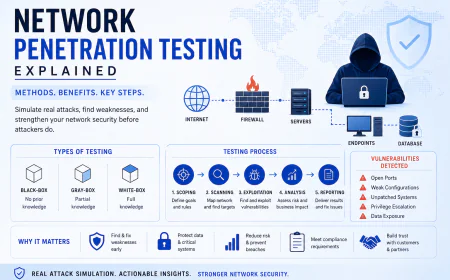
Periodic Vulnerability Assessments and Penetration Testing help identify weaknesses before attackers can exploit them.
Security assessments should be performed after major infrastructure changes and regularly.
Train Employees
Employees play an important role in maintaining network security.
Regular security awareness training helps users recognize phishing attempts, social engineering attacks, and unsafe online behavior.
How IntelligenceX Helps Organizations Strengthen Network Security
As cyber threats continue to evolve, organizations require a comprehensive approach to securing their network infrastructure.
IntelligenceX provides network security services designed to help businesses protect critical systems, monitor network activity, and reduce cyber risk across on-premises, cloud, and hybrid environments.
These services include:
- Network Security Assessments
- Penetration Testing
- Managed Detection & Response (MDR)
- Incident Response
- Cloud & DevOps Security
- Vulnerability Assessments
- Compliance Consulting
By combining advanced security technologies with experienced cybersecurity professionals, IntelligenceX helps organizations improve visibility, strengthen network defenses, and respond effectively to evolving cyber threats.
Conclusion
Modern organizations rely on secure, resilient networks to support business operations, digital transformation, and cloud adoption.
Network security is no longer limited to deploying firewalls-it requires a layered approach that combines access control, continuous monitoring, threat detection, network segmentation, encryption, and rapid incident response.
By implementing robust network security practices and continuously adapting to emerging threats, organizations can protect sensitive information, maintain business continuity, and build a stronger cybersecurity posture.
Frequently Asked Questions (FAQs)
1. What is network security?
Network security is the practice of protecting computer networks, connected devices, and data from unauthorized access, cyberattacks, and operational disruptions through security technologies, policies, and continuous monitoring.
2. Why is network security important?
It helps organizations protect sensitive information, prevent unauthorized access, reduce cyber risks, maintain business continuity, and support regulatory compliance.
3. What is the difference between IDS and IPS?
An Intrusion Detection System (IDS) detects suspicious activity and generates alerts, while an Intrusion Prevention System (IPS) automatically blocks malicious traffic to prevent attacks.
4. What is Zero Trust Network Security?
Zero Trust is a security model based on the principle of "Never Trust, Always Verify," requiring continuous authentication and authorization for every user and device requesting access.
5. What are the most common network security threats?
Common threats include ransomware, malware, phishing, Distributed Denial-of-Service (DDoS) attacks, insider threats, credential-based attacks, and Man-in-the-Middle (MitM) attacks.
6. How does a firewall improve network security?
A firewall filters inbound and outbound network traffic based on predefined security rules, helping block unauthorized access while allowing legitimate communications.
7. What is network segmentation?
Network segmentation divides a network into isolated sections to reduce the attack surface, improve access control, and limit the spread of cyber threats.
8. Can cloud environments benefit from network security?
Yes. Cloud environments require network security controls such as secure connectivity, encryption, continuous monitoring, and identity-based access management to protect cloud resources.
9. How often should organizations perform network security assessments?
Organizations should perform security assessments regularly and after significant infrastructure changes to identify vulnerabilities before they can be exploited.
10. Which industries require strong network security?
Healthcare, finance, government, manufacturing, education, retail, and technology organizations all require strong network security to protect sensitive information and maintain reliable operations.