
















Automated Threat Hunting: How AI Finally Catches What Your Security Team Misses
Four different options optimized for different user intents-problem-focused, action-oriented, ROI-focused, and benefit-driven. This gives you flexibility depending on your audience segment.

Your security team is doing everything right-they've implemented firewalls, deployed antivirus software, and trained staff on cybersecurity best practices. Yet threats still slip through. Why? Because modern cyberattacks have evolved faster than traditional defenses can keep pace. This is where automated threat hunting powered by artificial intelligence steps in, fundamentally transforming how organizations detect and respond to threats.
The Problem With Traditional Threat Detection
Reactive measures have been the mainstay of the cybersecurity field for many years. The security teams use the method of monitoring based on static rule sets to observe the network and wait for the appearance of the known threat signatures in the system. This scenario is quite similar to a situation where a police person tries to arrest a criminal based on past descriptions only-it is difficult to know that the criminal has changed his appearance and hence he simply moves past the police unnoticed.
The figures reflect the facts. According to threat hunting research, the average time to detect a breach is still very high at 181 days. At that stage, the attackers have already done severe damage, took away critical company information, and possibly messed up the operations of the company providing the data. The situation is more serious because 81% of the attacks today are not using malware but instead are employing techniques that are hard for even the most advanced detection methods based on signatures to catch.
Your security personnel, however expert they may be, are in an impossible situation. They are suffocating under alerts (many of them are false positives), and at the same time they are analyzing enormous amounts of logs, network traffic and behavioral data. A single human analyst would require hours, if not days, to sift through the information that AI can analyze in mere seconds. Thus, the outcome is that very important threats remain unnoticed while at the same time the investigation of false alarms consumes the resources.
What Is Automated Threat Hunting?
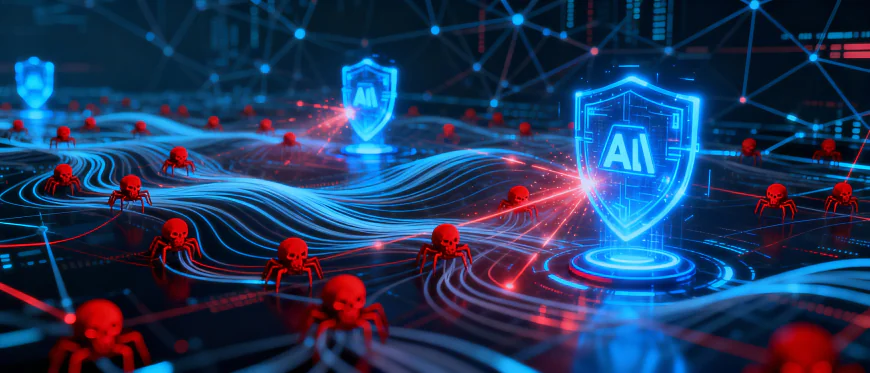
Automated threat hunting is the method that detects cyber threats and detects malicious actions by using technologies such as artificial intelligence, machine learning, and behavioral analytics, and it is performed throughout your entire infrastructure continuously without the need for constant manual intervention. The difference is that automated threat hunting does not wait like the passive detection systems to whose known patterns the threat corresponds and that is why the latter are called passive; the former-automated threat hunting-actively hunts for unknown threats, anomalies, and suspicious behaviors that indicate compromise.
An illustration of this is the difference between a security guard who is passive and waiting for an alarm to sound and a detective who is actively searching for suspicious patterns. The detective does not only react to the most blatant crimes-he/she is also alert to minor inconsistencies, odd behavior, and warning signs that might be overlooked by others.
AI-powered threat hunting platforms are designed to handle data from various sources: internal logs, endpoints, cloud environments, and external threat intelligence feeds. The system gets accustomed to the normal activity of your organization and hence it is able to build up users', systems', and networks' behavioral baselines. Whenever something goes off these baselines-be it unusual login attempts, suspicious file transfers, or abnormal network communication-the AI raises the flag immediately.
How AI Catches Threats Your Team Misses

Real-Time Anomaly Detection
Machine learning models can examine massive datasets in real-time and identify small deviations in a way that a human analyst would take hours to identify. For example, if an employee accesses sensitive files at 3 am, if a user logs in from a different country, or if the system communicates with unfamiliar external servers, those events trigger immediate alerts. The AI will learn your organization's specific patterns significantly increasing the accuracy of the alerts over typical rule-based systems.
Behavioral Correlations Humans Overlook
Security threats seldom happen as isolated incidents. A strange login attempt could seem innocuous until it is correlated with suspicious access on the network, which are two events that appear unrelated but are connected by AI to create a clear and actionable warning. Your security team may notice one anomaly but miss the other, but AI has never missed the patterns because it is able to analyze thousands of data points at the same time.
Continuous 24/7 Monitoring Without Fatigue
Attackers often exploit when the defenses are most vulnerable-usually when your security team is at their lowest staffing. Malware may have full auto-pilot control over systems for up to 99% of the time. Automated threat hunting systems run regardless of time. They are always checking user's behavior, network traffic, and system logs, and even create alarming behavioral patterns, regardless if someone is on watch. One study showed that AI-led systems achieved a threat return of 98% and a 70% decrease in incident response.
Predictive Threat Intelligence Integration
Modern automated threat hunting platforms incorporate threat intelligence feeds, learning about emerging attack techniques and threat actor behavior. This means the system doesn't just detect known threats-it anticipates attack patterns and can flag activity that matches techniques used by specific threat actors targeting your industry. You're no longer just defending against yesterday's attacks; you're defending against tomorrow's threats.
Reduced False Positives, Enhanced Signal-to-Noise Ratio
Traditional security tools generate thousands of daily alerts, many of which are false positives. This alert fatigue causes security teams to miss genuine threats buried in the noise. Automated threat hunting uses contextual analysis, behavioral baselines, and machine learning to filter out legitimate activity, escalating only alerts that show clear signs of malicious activity. This dramatically reduces the burden on analysts and ensures they focus on genuine threats.
The Human-AI Partnership That Works
Hype is far away from the most effective automated threat hunting. It is not about the extinction of human know-how. The most advanced systems utilize AI-driven automation along with human expert knowledge in a very effective feedback loop.
AI takes care of the continuous scanning and the initial analysis, detecting even the minute variation which would be humanly impossible to notice. On the other hand, humans provide the situation, the strategy, and the ability to make subtle decisions about the complicated incidents. The analysts confirm the AI's findings, look into suspicious patterns, and make decisions regarding the level of threat.
Some platforms go even further with the provision of automated response capabilities. When the system confirms the presence of a threat-for instance, it is the spread of ransomware-it can instantaneously cut off the devices that are under the attack, prevent the access of the compromised accounts, and stop the communication with the malicious IPs while at the same time notifying your security staff. This fast automated response is what distinguishes "we detected a threat" from "we prevented the damage".
Why Your Organization Needs Automated Threat Hunting Now
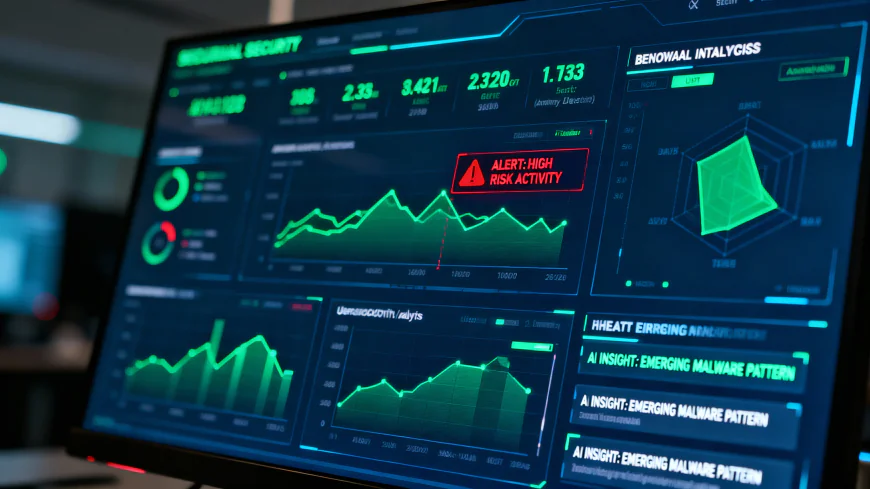
The cybernetic threat spectrum has completely changed. Cybercriminals have also begun to use AI, and one of their tactics is polymorphic ransomware which adapts at such a rapid rate that signature-based defenses are rendered powerless. They are utilizing AI-assisted password cracking and CAPTCHA breaking to get unauthorized users in. They are developing AI that can independently discover weaknesses, devise attack strategies, and carry them out with little human oversight.
An ability as remarkable as yours security team cannot match this level of automation just by relying on manual processes. The reasons are simple: they do not have the time, resources, or the superhuman cognitive ability that would be necessary to analyze the massive amount of data that is constantly being transferred through contemporary networks.
The detectable capability gap is closed by automated AI-powered threat hunting. Companies that are adapting AI-based threat hunting technology are reporting decreases in detection time from 181 days to less than 24 hours. This is the difference between a security breach that brings about ruin and one that is controlled before any serious damage is done.
The Future Is Intelligent Defense
The organizations with the combined use of human and machine intelligence will take over the future of cybersecurity. Cyber threats are advancing, and AI won't take your security team, but rather your security team will be more effective and their routine monitoring reduced, thus, allowing them to concentrate on strategic analysis and complex incident response.
The security team misses some threats that are not at all due to lack of skill or effort. They are usually just working at human speed while the attackers are at machine speed. Automated threat detection gives everyone the same chances, thus, nothing is missed.
The issue is not if your organization is able to afford the automated threat hunting implementation. The issue is whether you can afford it not to be in a time when the average breach detection time is counted in months, and the threat actors are getting more and more AI-assisted. So, start now and look into the threat-hunting capabilities-your organization's security stance is at stake.