
















AI-Powered Penetration Testing: When Machines Learn to Hack
AI is revolutionizing penetration testing by automating vulnerability discovery, generating exploits in real-time, and matching human expert performance - but it's also empowering attackers. Discover how artificial intelligence is transforming both offensive and defensive cybersecurity in 2025. Explore AI-powered penetration testing in 2025: automated vulnerability scanning, exploit generation, autonomous attack chains, and the dual-use dilemma where AI tools empower both ethical hackers and cybercriminals simultaneously.

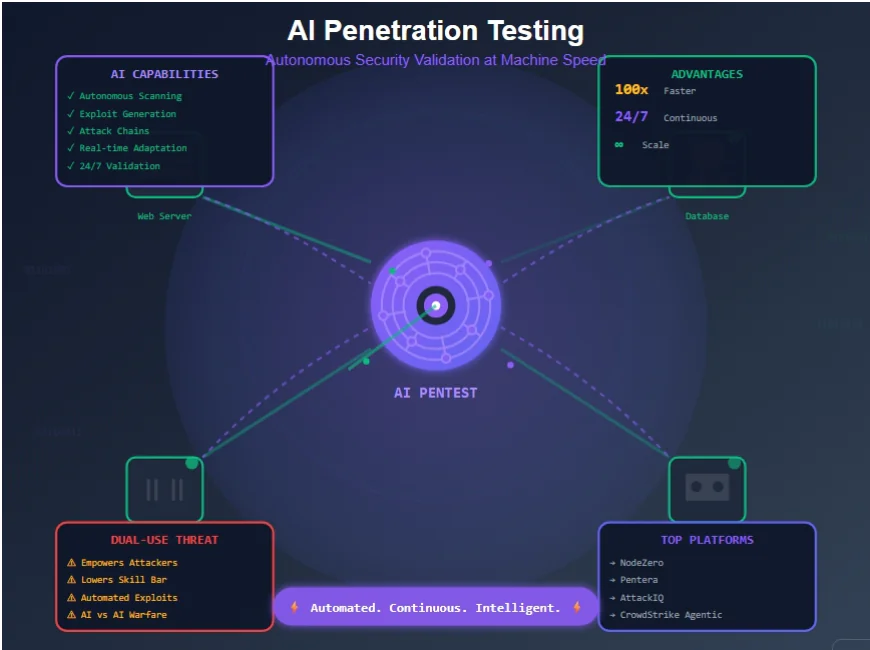
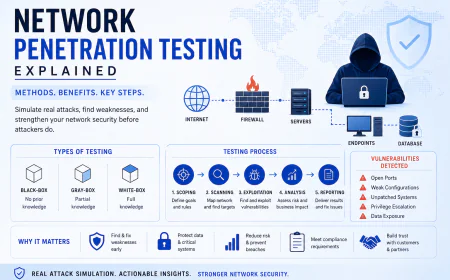
Artificial intelligence has fundamentally changed penetration testing. What once required teams of skilled security professionals working for weeks can now be accomplished by AI systems in hours or even minutes. This transformation represents both an enormous opportunity for defenders and a significant threat as the same tools that empower ethical hackers are accessible to malicious actors.
The AI Advantage in Penetration Testing
Traditional penetration testing faces a critical challenge: the human bottleneck. Organizations need constant security validation, but skilled penetration testers are expensive, scarce, and slow. AI changes this equation entirely.
Key Benefits:
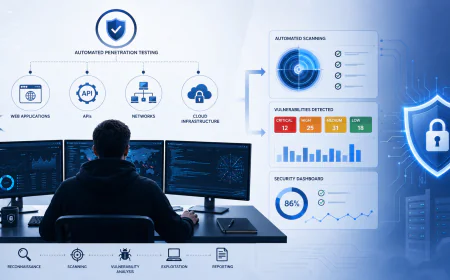
1. Speed and Scale AI-powered tools scan thousands of endpoints simultaneously, identifying vulnerabilities at machine speed. What took days now takes minutes.
2. Continuous Testing Unlike manual pentests conducted quarterly or annually, AI systems provide 24/7 security validation, adapting to infrastructure changes in real-time.
3. Consistency Human testers have good and bad days. AI maintains consistent performance, never missing obvious vulnerabilities due to fatigue or oversight.
4. Cost Efficiency While top-tier penetration testers command premium rates, AI tools offer enterprise-scale testing at a fraction of the cost.
How AI Penetration Testing Actually Works
Autonomous Vulnerability Discovery
Modern AI pentesting platforms don't just scan for known vulnerabilities they discover new ones through intelligent exploration:
- Network Mapping: AI autonomously discovers assets, services, and relationships
- Attack Surface Analysis: Identifies potential entry points and weak configurations
- Exploit Chain Generation: Links multiple vulnerabilities to achieve objectives
- Privilege Escalation: Finds paths from low-privilege access to domain control
Real-World Example: NodeZero
NodeZero by Horizon3.ai exemplifies autonomous pentesting. Unlike traditional scanners, it dynamically traverses networks to chain together exposures just like a real adversary:
- Initiates attacks without credentials or prior network knowledge
- Discovers vulnerabilities through active exploitation attempts
- Chains multiple small weaknesses into critical compromises
- Provides proof of exploitability, not just theoretical risks
- Generates actionable remediation guidance
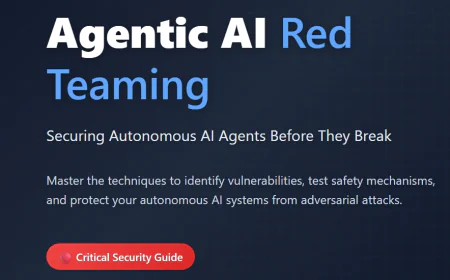
The Agentic AI Revolution
The latest evolution involves agentic AI systems that make independent decisions throughout the attack lifecycle:
Planning: Analyzes reconnaissance data to determine optimal attack paths
Adaptation: Modifies tactics when defenses block initial approaches
Learning: Improves techniques based on success and failure
Orchestration: Coordinates multi-stage attacks across different systems
AI's Offensive Capabilities: What Machines Can Do
1. Automated Exploit Generation
AI systems can now generate working exploits for discovered vulnerabilities:
- Analyzes vulnerability descriptions and proof-of-concept code
- Generates customized payloads for specific environments
- Adapts exploits to bypass security controls
- Tests exploit reliability before deployment
2. Social Engineering at Scale
AI-powered phishing represents a quantum leap in threat sophistication:
- Generates hyper-personalized messages using scraped data
- Creates contextually appropriate lures based on victim profiles
- Synthesizes realistic voice recordings for vishing attacks
- Adapts messaging based on victim responses
3. Evasion and Obfuscation
AI excels at evading detection:
- Polymorphic code generation that changes with each deployment
- Behavioral mimicry to blend with normal network traffic
- Automated testing against security products to find bypasses
- Real-time adaptation to defensive responses
4. Password and Credential Attacks
Machine learning dramatically improves credential attacks:
- Password pattern recognition and prediction
- Intelligent credential stuffing with likely combinations
- Hash cracking using neural network password models
- Leaked credential correlation across breaches
The Dual-Use Dilemma: Empowering Both Sides
The same AI capabilities that revolutionize legitimate security testing are equally available to attackers. This creates unprecedented challenges:
For Defenders
Advantages:
- Continuous security validation at scale
- Early vulnerability discovery before attackers
- Automated remediation prioritization
- Democratized access to expert-level testing
Challenges:
- AI-powered attacks evolve faster than defenses
- Detection systems struggle with adaptive AI adversaries
- Skill gaps as traditional expertise becomes less relevant
For Attackers
New Capabilities:
- Lowered technical skill requirements
- Automated reconnaissance and exploitation
- Scalable attack campaigns
- Rapid adaptation to defensive measures
Real Example: In 2025, a cybercriminal used Claude AI to develop and sell multiple ransomware variants for $400-$1,200 each. The attacker had basic coding skills but leveraged AI to generate sophisticated malware with advanced evasion capabilities.
Leading AI Pentesting Platforms
1. NodeZero (Horizon3.ai)
Autonomous penetration testing that mimics real adversary behavior. Continuously validates security posture without human intervention.
2. Pentera
Automated security validation platform that safely exploits vulnerabilities to prove real-world risk without causing damage.
3. AttackIQ
Continuous security validation through automated adversary emulation based on MITRE ATT&CK framework.
4. Randori (IBM)
Attack surface management with continuous automated penetration testing of external assets.
5. CrowdStrike Agentic Security
AI agents that handle critical security workflows and automate time-consuming pentesting tasks at machine speed.
The Human Element: Why Experts Still Matter
Despite AI's impressive capabilities, human expertise remains critical:
Complex Business Logic AI struggles with application-specific logic flaws that require business context understanding.
Creative Problem-Solving Novel attack vectors still require human creativity and lateral thinking.
Strategic Assessment Understanding business risk and prioritizing findings needs human judgment.
Ethical Boundaries Determining appropriate testing scope and methods requires human oversight.
Validation and Context AI generates findings; humans provide context, validation, and strategic recommendations.
Best Practices for AI-Augmented Pentesting
For Security Teams
1. Embrace Hybrid Approaches Combine AI automation for breadth with human expertise for depth.
2. Continuous Validation Shift from periodic pentests to continuous AI-powered security validation.
3. Prioritize Remediation Use AI to identify the most critical vulnerabilities based on exploitability and business impact.
4. Upskill Teams Train security professionals to work alongside AI tools effectively.
5. Test Defenses Against AI Validate security controls using AI-powered attack simulations.
For Organizations
1. Deploy Responsibly Ensure proper authorization and controls for AI pentesting tools.
2. Monitor AI Tool Usage Track how AI security tools are being used to prevent misuse.
3. Update Security Policies Adapt policies to address AI-specific capabilities and risks.
4. Invest in Detection Implement AI-powered detection to counter AI-powered attacks.
The Future: AI Security Arms Race
The trajectory is clear: AI will become the dominant force in both offensive and defensive security.
Expected Developments:
Fully Autonomous Red Teams AI systems conducting complete penetration tests without human guidance.
Real-Time Adaptive Defense Security systems that learn and adapt as fast as AI attackers.
Adversarial AI Battles Attacker AI probing defender AI in continuous machine-speed warfare.
Democratized Expertise Expert-level security testing accessible to organizations of all sizes.
New Attack Vectors AI discovering novel vulnerability classes humans never considered.
Ethical Considerations
The penetration testing community must address critical questions:
Responsible Disclosure: When AI discovers zero-days, who's responsible for disclosure?
Access Control: Should AI pentesting tools require licensing or certification?
Dual-Use Technology: How do we prevent offensive AI tools from empowering criminals?
Accountability: When AI causes unintended damage during testing, who's liable?
Conclusion: Adapt or Fall Behind
AI has permanently altered the penetration testing landscape. Organizations clinging to traditional quarterly manual pentests are already falling behind. The future belongs to continuous, AI-powered security validation combined with human expertise for strategic oversight.
Key Takeaways:
- AI pentesting offers speed, scale, and consistency impossible for humans alone
- The same tools empower both defenders and attackers
- Human expertise remains essential for context, creativity, and strategy
- Continuous AI-powered validation is becoming the security standard
- Organizations must adopt AI tools or face AI-powered adversaries unprepared
The question isn't whether to embrace AI in penetration testing—it's whether you'll adopt it before your adversaries use it against you.
For security teams: The AI pentesting revolution is here. Evaluate leading platforms, train your teams, and implement continuous automated security validation before attackers exploit the gaps you haven't discovered.