

















Microsoft to Strengthen Entra ID Authentication Security with Advanced Content Security Policy (CSP) Update in 2026
Microsoft is preparing a major update for Entra ID in 2026 that introduces a stronger Content Security Policy to reduce script injection risks, tighten control over authentication flows, and block unauthorized content sources. The upgrade aims to improve identity security for organizations and help them defend against modern browser-based threats.


Microsoft has made a noteworthy security improvement that will protect its customers from unauthorized script injection attacks while they are being authenticated through Entra ID. The tech giant disclosed that it would soon be rolling out a modernized Content Security Policy (CSP) framework that would limit the execution of scripts to just the recognized Microsoft sites when users start signing in to the Entra ID services in the second half of 2026.
Enhanced Protection Against Script Injection Attacks
The next update will be a major step forward in the battle against cross-site scripting (XSS) vulnerabilities, which have continuously troubled authentication systems. With the adoption of more stringent CSP controls, Microsoft intends to implement a security environment that is highly resistant and at the same time very user-friendly for the millions of users who rely on Entra ID for their secure access to cloud applications and services. As per the official announcement from Microsoft, the advancement of CSP will basically change the authentication process completely in terms of how scripts are approved and executed. In the new policy, only the downloads of scripts from the domains designated by Microsoft and related to the trusted content delivery network will be allowed, and the execution of the inline script will be confined to the sources that have been specifically authorized and authenticated by Microsoft. With this dual strategy, any malicious code that tries to sneak in through the authentication process will be detected and shut down before it can do anything. This upgrade in security is particularly directed at the sign-in experiences through web browsers at the URLs beginning with login.microsoftonline.com. Notably, the Microsoft Entra External ID services are not affected by this in any way, which means that the organizations using external identity solutions will be able to carry on their operations just as before.

Rollout Timeline and Implementation Schedule
Microsoft has laid down a detailed execution plan, with the worldwide distribution of this safety patch being planned to start around the mid-to-late October 2026. By using this gradual manner, firms are given a long time to adjust their authentication procedures, perform tests on the current setups, and find out possible compatibility problems before the obligatory update takes place. The firm is leaning towards all the companies that are using Entra ID to start checking their sign-in flows right away so as to ensure flawless operation after the update. This early testing time is of utmost importance, for companies need to check that their authentication interactions still have the same user-friendly characteristics, and at the same time, they do not cause any friction or interruptions in the logging process.

Part of Microsoft's Broader Security Initiative
This security improvement is something over which Microsoft is working as part of its Secure Future Initiative (SFI), an extensive, multi-year plan that began in November 2023 and which was remarkably magnified in May 2024. The SFI was born out of the U.S. Cyber Safety Review Board (CSRB)'s severe criticism report which concluded that the security culture of Microsoft needed a major overhaul and improvement. The CSP update is a clear indication of Microsoft's resolve to incorporate security relations among the utmost top in product design and development. The company has entirely transformed its method by treating them as a priority of the whole product ecosystem replacing afterthoughts with prevention of threats and user protection.

Comprehensive Security Measures Announced
This month, Microsoft presented its most recent progress report, which included a number of security accomplishments and implementations within the framework of the SFI. The corporation announced that it had performed the rollout of over 50 new detection systems throughout its infrastructure, which are especially made to identify and react to the most important attack tactics, techniques, and procedures that are being employed by the threat actors. Among the various security accomplishments that were mentioned in the report, one of the most impressive was the use of multi-factor authentication (MFA) in the organization. Microsoft mentioned that the resistance to phishing MFA that has been implemented across its user base and devices has reached a whopping 99.6% adoption rate, which has significantly lessened the impact of attacks based on stolen credentials against its services.

Additional Security Infrastructure Changes
Microsoft besides the CSP update has presented a lot of other great security improvements too. The company has even imposed MFA on all users of Azure services within all Microsoft services including those that were not using MFA at the time. The standardization of MFA across all Microsoft services ensures that there is a uniform level of security for all customers. Also, Microsoft has enhanced the automatic recovery with Quick Machine Recovery feature and further has allowed more passkey and Windows Hello biometric authentication. Additionally, UEFI firmware and drivers have been undergoing tremendous memory safety protocol improvements as a result of the adoption of the Rust programming language which in turn has made the entire elimination of certain types of memory-related vulnerabilities feasible. 95% of Microsoft Entra ID signing virtual machines have been effectively transitioned by the company from regular Azure environments to Azure Confidential Compute environments thus the authentication infrastructure's isolation and protection that is vital to the organization have increased considerably. The company, in addition, has shifted 94.3% of the Microsoft Entra ID security token validation operations to its standard identity Software Development Kit (SDK). Additionally, Microsoft has done away with Active Directory Federation Services (ADFS) in its productivity environment completely thus centralizing the authentication infrastructure around the most modern and secure platforms. The company has not only cleaned up the infrastructure but also decommissioned 560,000 inactive and outdated tenants and 83,000 non-used Microsoft Entra ID applications in its production and productivity environments.

Guidance for Organizations
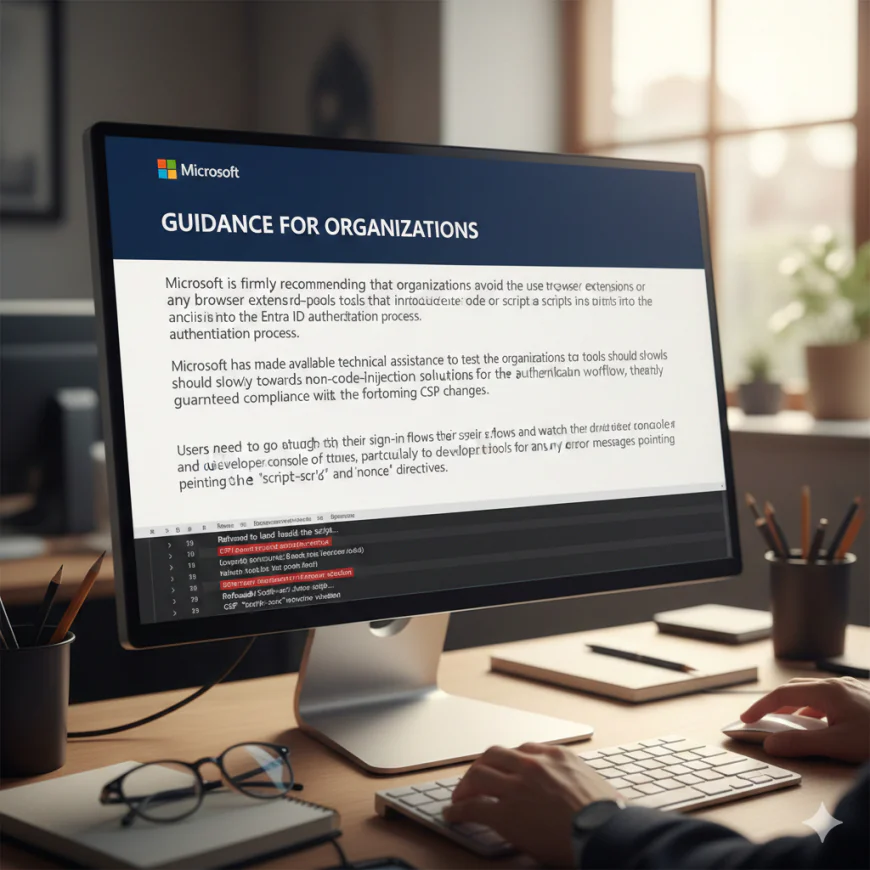
Microsoft is firmly recommending that organizations avoid the use of any browser extensions or third-party tools that introduce code or scripts into the Entra ID authentication process. Organizations that depend on such tools should slowly move towards non-code-injection solutions for the authentication workflow, thereby guaranteed compliance with the forthcoming CSP changes. Microsoft has made available technical assistance to the organizations to test their systems and identify any compatibility issues. Users need to go through their sign-in flows and watch the developer console of the browser, particularly focusing on the Console tool in developer tools for any error messages pointing to "Refused to load the script" violations of the "script-src" and "nonce" directives.
Ongoing Security Commitment
Microsoft's all-encompassing security initiative is full of successes, and 98 percent of the production infrastructure being tracked centrally has had a great impact on the threat hunting capabilities. The organization has carried out entire network device inventory management and employed refined asset lifecycle management practices. Code signing has practically been limited to the production identities only, which has drastically cut down the chances of unauthorized or compromised code being pumped into Microsoft's infrastructure unobserved. As part of its security measures, Microsoft has been proactive in publishing up to 1,096 CVEs and donating $17 million to bug bounty programs, hence indicating its continuous commitment to responsible vulnerability disclosure and community engagement.