












Using OSINT and Reconnaissance to Strengthen Malware Analysis
Discover how cybersecurity analysts leverage OSINT (Open Source Intelligence) and reconnaissance techniques to uncover the story behind malware. Learn how open data, domain research, and threat intelligence transform static malware indicators into actionable insights for defense and attribution.
Introduction
Malware analysis reveals what a malicious file does, but it doesn’t always tell us the full story.
That’s where OSINT (Open Source Intelligence) and reconnaissance come in — helping analysts uncover who, how, and why behind attacks.
By blending technical analysis with open intelligence, defenders gain a clearer picture of threat actors, infrastructure, and intent.
Why Reconnaissance Matters in Malware Analysis
In malware research, reconnaissance means researching, not attacking.
Analysts perform recon to identify:
-
The attacker’s command-and-control (C2) network
-
Hosting or domain registration patterns
-
Shared certificates and infrastructure reuse
-
Victim profiles or industry targeting
This intelligence guides containment, attribution, and defense strategies.
Key OSINT Sources and Tools
| Category | Purpose | Examples |
|---|---|---|
| Malware Sandboxes | Behavioral & network analysis | ANY.RUN, Hybrid Analysis |
| Threat Intel Feeds | IOC enrichment | VirusTotal, AlienVault OTX, MISP |
| WHOIS & DNS History | Domain registration & age | WhoisXML, SecurityTrails |
| Certificate Transparency | TLS/SSL certificate reuse | crt.sh, Censys |
| Passive DNS | Infrastructure mapping | RiskIQ, PassiveTotal |
| Public Code Repos | Leaked configs or tool reuse | GitHub, Sourcegraph |
| Paste Sites | Leaked credentials / configs | Pastebin (for verified OSINT) |
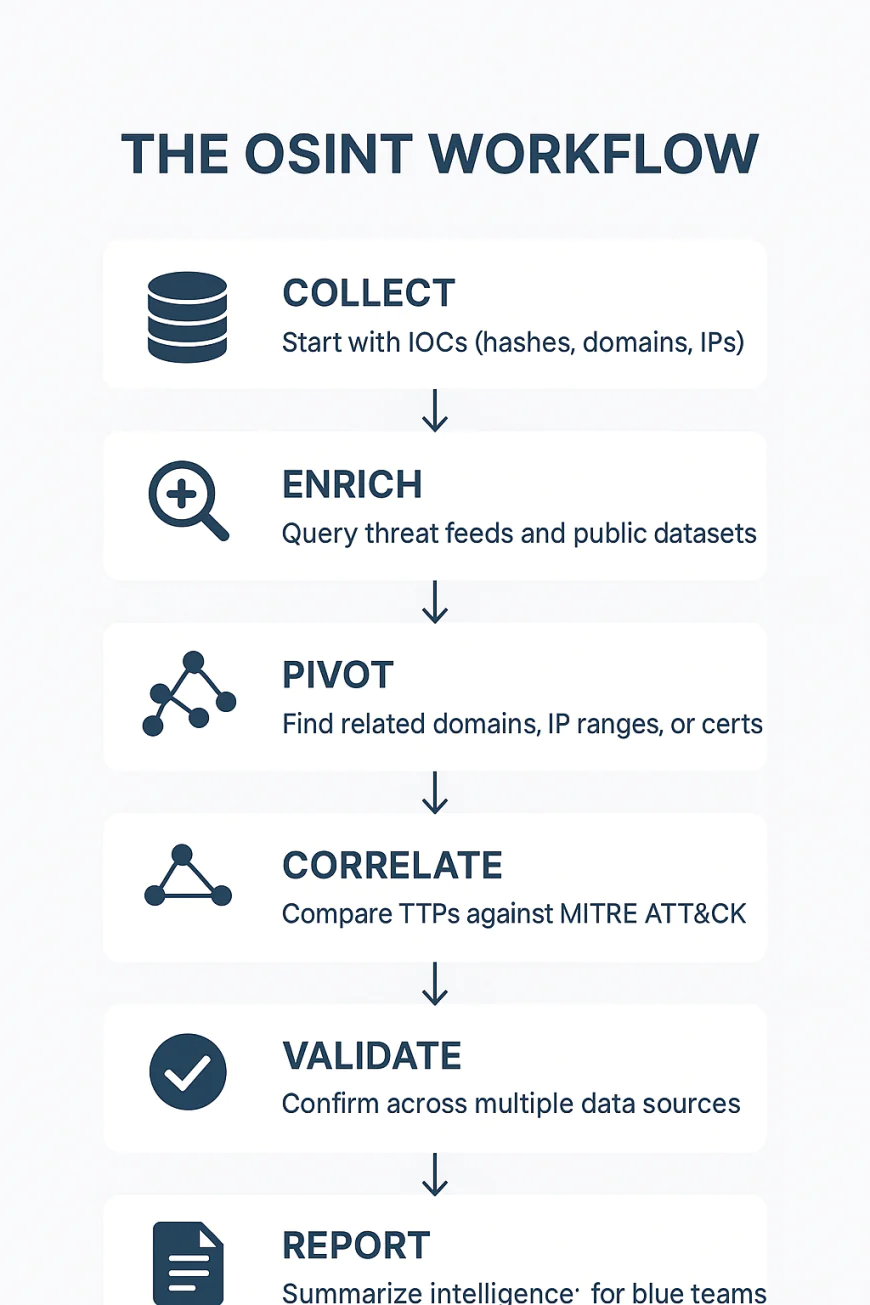
The OSINT Workflow
-
Collect – Start with IOCs (hashes, domains, IPs).
-
Enrich – Query threat feeds and public datasets.
-
Pivot – Find related domains, IP ranges, or certs.
-
Correlate – Compare TTPs against MITRE ATT&CK.
-
Validate – Confirm across multiple data sources.
-
Report – Summarize intelligence for blue teams.
Example (Fictional) Scenario
A suspicious executable contacts hxxp://updates-check[.]net/api.
An analyst uses OSINT to investigate:
-
Domain registered 6 days ago with privacy protection.
-
Shared TLS certificate with several phishing domains.
-
Passive DNS links IP to other malware campaigns.
Result: The malware belongs to a broader phishing operation targeting finance companies.
Ethical & Legal Boundaries
OSINT for malware analysis is about defense and research, not intrusion.
Always:
-
Use open, publicly accessible data.
-
Avoid live interaction with malicious infrastructure.
-
Follow platform terms and responsible disclosure policies.
Defensive Benefits
-
Faster IOC correlation and enrichment
-
Stronger attribution to known threat groups
-
Improved detection rules (YARA, SIEM queries)
-
Shared intelligence for collaborative defense
Conclusion
Combining OSINT and malware analysis empowers defenders to see the full attack landscape — from a single sample to a global campaign.
By mastering reconnaissance ethically, analysts turn raw indicators into actionable intelligence, strengthening their organization’s cyber resilience.